
Biomedical Engineering: What Students Learn and Where Graduates Work
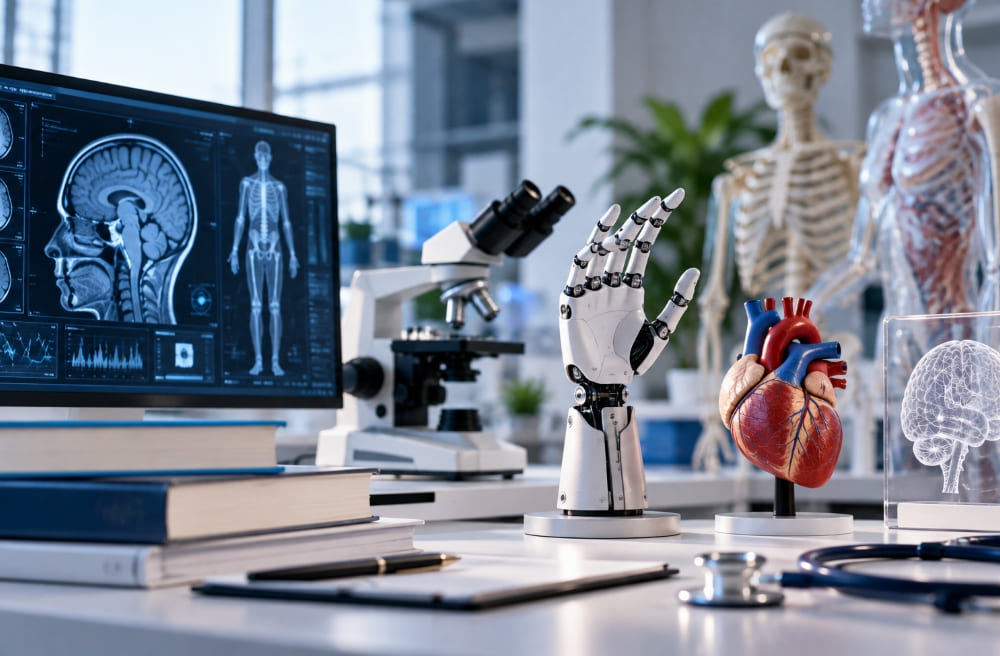
Who sets up the MRI while the doctor makes the diagnosis?
In a modern clinic, doctors work with equipment they did not design or maintain themselves: MRI scanners, ventilators, infusion pumps, patient monitors and laboratory analysers. Behind every one of these devices is an engineer who helped develop it, commission it, calibrate it and train medical staff to use it.
This is the field of biomedical engineering. It sits at the intersection of two worlds and requires an understanding of both electronics and human physiology. Let’s look at what students actually study during the four years and what career paths are available after graduation.
Why is this field considered challenging?
Because students have to learn two areas at the same time. A conventional electronics engineer does not necessarily need to know how the heart works. A doctor does not need to be able to read electrical schematics. A biomedical engineer needs to understand both.
Hochschule Anhalt describes its graduates as professionals who “translate” between medical specialists and engineers. That is a fairly accurate description of the job. A doctor may say that a clearer signal is needed during an examination. The engineer understands that the problem may involve noise filtering and develops the appropriate technical solution.
The programme in Almaty is interdisciplinary and practice-oriented. It covers everything from modelling biomedical processes and designing electronic circuits for recording and processing biosignals to developing medical devices.
What do the four years of study look like?
The programme develops progressively: first the foundations, then specialised subjects and finally practical application.
First year: Foundations
Mathematics, physics, electrical engineering and programming. There is very little medicine at this stage, and that is intentional: without a foundation in electronics, it is difficult to work meaningfully with biosignals.
English is studied throughout the programme because the entire course is taught in English. German is also included in the curriculum.
Second year: The human body as a system
Anatomy and physiology are introduced, but from an engineering perspective. Students study the human body as a system of signals, pressures, flows and feedback mechanisms.
At the same time, the technical component becomes more advanced: circuit design, electronics, signal processing and programming for measurement tasks. This is when students begin to understand why topics such as Fourier series were introduced in the first year.
Third year: Specialisation and first practical experience
Students move into specialised areas such as medical instrumentation, biosensors, signal and image processing, and modelling and simulation of biomedical processes.
Internships begin in the third year, both in Kazakhstan and Germany. The university is actively developing opportunities for internships and practical experience at German companies. These are not simply two-week formal placements.
Fourth year: Projects and the final thesis
The final year focuses on project work, laboratory activities and the Bachelor’s thesis. The thesis may be based on a real task from a company or clinic because, in a practice-oriented education model, the goal is to connect the final project with a real-world engineering problem rather than simply produce a literature review.
Another area that applicants rarely think about in advance is regulation. Medical devices are subject to strict requirements, so engineers need to understand relevant regulations and standards. Without this knowledge, even a technically successful device may not make it to market.
What can students do by graduation?
If we strip away the academic terminology, the skill set looks like this:
- read and design electronic circuits for acquiring and processing biosignals;
- programme data-processing systems, including signal and medical-image processing;
- build and validate models of biomedical processes;
- commission, diagnose and maintain medical equipment;
- understand medical-device requirements and technical documentation;
- communicate effectively with both doctors and engineers without losing important technical details.
The last point may sound like a soft skill, but in practice it can make a significant difference between a valuable specialist and a technically competent employee.
What jobs do graduates take?
There is no single career path. Graduates can move into several professional areas, each with a different type of work.
Medical Equipment Service Engineer
This is one of the most common positions and often the first job after graduation. Responsibilities include diagnostics, repairs, preventive maintenance, commissioning equipment and training clinical staff.
The work may involve travel and site visits. Job requirements often include the ability to read electrical schematics and technical documentation, component-level repair skills and English for technical documentation and manufacturer training.
Clinical Engineer in a Hospital
A clinical engineer is responsible for the equipment fleet of a particular medical facility, including intensive care, diagnostics, sterilisation and physiotherapy equipment.
Responsibilities include maintaining technical documentation, planning maintenance, participating in procurement and assessing what equipment the hospital actually needs.
The role tends to involve more stability and less travel, but the engineer must keep track of dozens of different devices at the same time.
Medical Device Development Engineer
This role is usually based at a medical-device manufacturer. Engineers work on circuit design, prototyping, testing and preparing products for serial production.
Many such positions are located outside Kazakhstan, particularly in Europe and the United States.
This career path is often chosen by graduates who continue their education in Germany or pursue a Master’s degree after their Bachelor’s.
Medical Device Regulatory and Quality Specialist
This is a less visible career path for applicants, but its importance grows as the medical-device market develops.
Responsibilities include product registration, compliance with standards, quality audits and preparing technical documentation for regulatory authorities.
It can be a good option for people who like engineering but are more interested in documentation and processes than hands-on electronics.
Technical Specialist at a Medical Equipment Distributor
This is a combination of engineer and product specialist. The role can involve selecting equipment for a clinic’s needs, preparing technical specifications, launching projects and training customers.
It requires strong communication skills and an understanding of the market. At the same time, it can offer opportunities to take on responsibility beyond purely technical service work.
Where do graduates work in Kazakhstan?
The market has its own specific features. Most medical equipment in Kazakhstan is imported, so the main employers are not necessarily manufacturers but service and distribution companies, local offices of international vendors and healthcare organisations themselves.
Demand is driven by two factors. First, medical technology is becoming more complex, so it needs to be serviced by people with specialised training rather than general electrical skills. Second, the amount of medical equipment is increasing, while relatively few specialists understand both the physics and electronics behind it.
For graduates with a German degree, there is a third option: working for European companies or continuing their career in Germany.
Who is this field suitable for?
It may be worth considering if you:
- enjoy physics and mathematics but want to see the results of your work in a real device;
- are interested in medicine but do not want to become a doctor;
- are ready to keep learning throughout your career because technology changes constantly;
- are comfortable taking responsibility for equipment that can affect patient health and safety.
It may be less suitable if you want purely research-based work without engineering routines or if electronics and programming do not appeal to you. They make up a significant part of the profession.
What should you do next?
If the field sounds interesting, review the programme content and UNT requirements on the admissions page. The required subject combination is Physics and Mathematics, so it is worth preparing well in advance.
Before submitting your application, it can also be useful to visit a clinic or medical equipment service company and observe what an engineer actually does. It is one of the best ways to determine whether the profession is right for you.
More information about programmes and studying is available in the university blog.