
Double Degree: What Graduates of Anhalt International University Receive
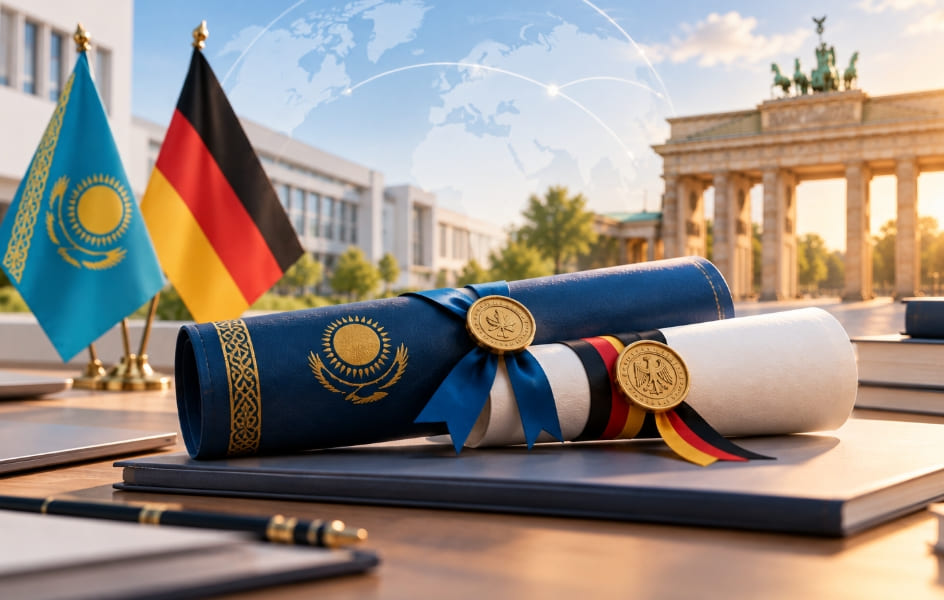
Two degrees instead of one — and what they actually mean
“Double degree” sounds impressive, but prospective students and their parents usually want specific answers: What exactly will they receive after four years? Where is each degree recognised? And will the second degree actually be useful or simply become another document in a folder?
Here is what graduates of Anhalt International University receive, which programmes offer a double degree, what requirements students need to meet and what they can do with these qualifications afterwards.
What does a double degree mean in this case?
The term “double degree” is used in different ways in higher education. Sometimes it refers to a joint programme between two universities, sometimes to a certificate confirming that a student completed part of their studies abroad, and sometimes simply to a partnership agreement.
The situation here is different. Anhalt International University is a branch of the German public university Hochschule Anhalt in Almaty. Hochschule Anhalt is the first German university to offer German academic programmes in Kazakhstan and award German-standard degrees.
This means that students do not study an “adapted” version of a programme. They follow a German programme taught by German lecturers while remaining part of the Kazakh higher education system. This is why graduates receive two degree documents.
Which two degrees do graduates receive?
| German degree | Kazakh degree |
|---|---|
| Awarded by Hochschule Anhalt, a public university in Germany | Awarded within the Kazakh higher education system |
| Relevant for the European labour market and applications to Master’s programmes in the EU | Relevant for the Kazakh labour market, government organisations and employment within Kazakhstan |
| Provides a preferential basis for applying for a German work visa | Does not require additional recognition or confirmation within Kazakhstan |
An important point: this is not a single diploma with two seals, nor is one document simply an attachment to the other. Graduates receive two separate degree documents: a Kazakh degree and a German degree.
Which programmes offer the double degree?
The double-degree model applies to engineering programmes where students are enrolled both at the Almaty branch and at the main university in Germany:
- Electrical Engineering and Information Technology;
- Biomedical Engineering.
Both are four-year Bachelor’s programmes taught on campus in English. These are also the two programmes for which state-funded educational grants are available.
The model is different for International Business and Logistics Management. Students are enrolled directly at the main university in Germany and receive a degree from a German public university. These programmes are tuition-based and follow a hybrid format with an on-site semester in Germany.
That is why the question “Will I definitely receive two degrees?” should always be asked in relation to a specific programme. More information about each programme is available on the admissions page.
How is this different from exchange programmes and partner universities?
The key difference is the student’s academic status. In an exchange or partnership programme, students are usually enrolled at a Kazakh university, while the foreign university confirms the courses they have completed. With the Anhalt double-degree model, students are part of the German university system from their first semester.
The practical result is that the German degree is a degree awarded by a German public university rather than a certificate of participation in a joint programme. Employers therefore do not need additional explanations about what kind of exchange or partnership programme the student completed.
There is also a difference in the content of the programme. The curriculum is developed by the German side, which is why the education has a strong practical focus. To understand this approach better, see our guide to universities of applied sciences and how they differ from traditional universities.
What does a student need to do to receive both degrees?
A double degree is not awarded automatically simply because a student is enrolled. There are admission requirements as well as academic requirements that must be met during the programme.
For admission. The required UNT subject combination is Physics and Mathematics. A minimum of 70 points is required for a state grant, while paid admission starts from 50 points and also requires an internal examination in Physics and Mathematics. Applicants must also demonstrate B2-level English proficiency: IELTS Academic 5.5 or higher, TOEFL iBT 69 or higher, or the university’s internal English examination. The complete list of required documents is available in the admission rules.
During the programme. Students must complete the curriculum according to German academic requirements, undertake laboratory and project work and complete internships from the third year. Partner companies include major Kazakh employers such as Kazakhstan Temir Zholy.
German language. German is not required for admission, but it is included in the curriculum. Once a student reaches B2 level, an additional option becomes available: transferring to the main university in Germany after the fifth semester.
What does the German degree offer after graduation?
There are three possible paths, and they are not mutually exclusive.
Working in Germany. A degree from Hochschule Anhalt provides a preferential basis for applying for a talent visa for subsequent employment in Germany. This is not a guarantee of a job offer, but it can make the path to employment in Germany more direct.
Master’s studies in Europe. A degree from a German public university can be used when applying to European universities for further study, without the same additional recognition procedures that may apply to graduates of universities outside the European higher education system.
Working for international companies in Kazakhstan. German engineering companies operating in the Kazakh market can readily understand both the degree and the educational standards behind it. German industrial companies also visit the campus to meet students before graduation.
Why is the Kazakh degree useful if there is already a German one?
Because many graduates remain in Kazakhstan, at least during the first years of their careers.
The Kazakh degree reduces administrative barriers within the country. It does not require nostrification, is recognised for employment in government organisations and can be used when applying for a Master’s programme in Kazakhstan.
In other words, the double degree leaves the choice open. A student does not have to decide at 17 whether they will ultimately stay in Kazakhstan or move abroad. Both options remain available until graduation.
Who can benefit from a double degree?
It may be worth considering if you:
- are considering a career with international or European companies;
- want to keep the option of moving abroad open but are not ready to leave immediately after school;
- plan to pursue a Master’s degree abroad after completing your Bachelor’s;
- are choosing engineering and are ready for a demanding programme in Physics and Mathematics;
- want an internationally recognisable degree that employers can understand without lengthy explanations.
It may be less relevant if you are certain that you want to work exclusively for a local Kazakh company and do not plan to pursue an international career. In that case, the second degree may be an additional qualification rather than a decisive factor in your career path.
Where should you start?
Start by checking three things: your UNT subject combination, your English level and your readiness for an engineering programme. This is enough to determine whether a double degree is a realistic option for you this year.
The next steps are the language test or internal examination, submission of documents and the start of studies in September.