
Does an Engineer Need German, and How to Reach B2?
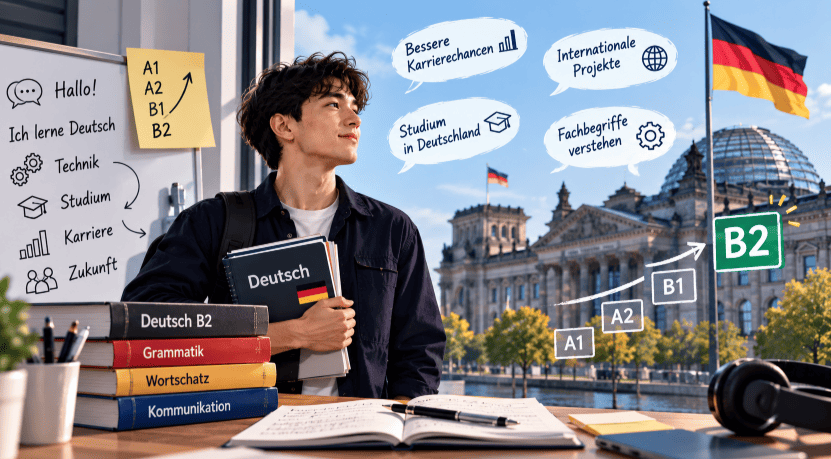
English Opens the Degree, German Opens Germany
German is not required for admission to an engineering programme. At the Branch of Anhalt University of Applied Sciences in Kazakhstan, for example, classes are taught in English and German is studied from the first year.
But if your goals are linked to Germany (transferring to the main university, an internship, work), you cannot do without German. English is enough for lectures and research papers. For everyday life, work on the shop floor and conversations with colleagues in Germany, you need German, usually at B2 level or higher.
Let us look at what this level means, why an engineer needs it and how to realistically reach it during a bachelor’s degree.
What the B2 Level Means
Language proficiency levels are described by the Common European Framework of Reference, CEFR. It is the same for English, German and other European languages.
| Level | What a person can do |
|---|---|
| A1 and A2 | Basic communication: introducing yourself, buying a ticket, understanding simple announcements |
| B1 | Copes in everyday situations, understands the main points on familiar topics |
| B2 | Speaks fluently with native speakers, understands lectures and professional texts, writes well argued texts |
| C1 and C2 | Close to native level: stylistic nuance, complex academic texts |
B2 is the level at which language stops being an obstacle. A person can take part in a meeting, read technical documentation and explain a problem on the shop floor to a colleague.
Why Does an Engineer Need German If Studies Are in English?
In the lecture hall, English really is enough. The question is what happens outside it.
- Transfer to Germany. On the branch’s programmes, transfer to the main university is possible after the 5th semester. One of the conditions is confirmed German at B2 level.
- Internships. From the 3rd year, internships are planned at engineering companies in Kazakhstan and Germany. At a German company, the working language on the shop floor and in many meetings is German, even if management speaks English.
- Work after graduation. German employers, especially small and medium sized firms, expect engineers to have working German. This applies to instructions, standards and correspondence with clients.
- Companies with German capital in Kazakhstan. Knowing the language helps you settle into the team faster and understand the parent company’s standards.
Representatives of German companies visit the university regularly. Recently, for example, the branch was visited by representatives of Daimler Buses, BARMER and Kühne Group. At such meetings, students who speak German feel noticeably more confident.
How Long Does It Take to Reach B2
There is no exact figure: it depends on your starting level, how regularly you study and how much you practise. For students whose first language is Kazakh or Russian, German usually progresses more slowly than English at the start. Grammar with cases and word order takes time.
The good news is that on the branch’s programmes German starts in the first year, which gives students about two and a half years before the end of the 5th semester. This can be enough if you study systematically and do not limit yourself to scheduled classes. An individual pace can be discussed with the language teachers.
How to Learn German Alongside an Engineering Programme
Combining a language with mathematics and physics is not easy. Here is an approach that works for many students:
- A little every day. 20 or 30 minutes of vocabulary and listening every day is better than three hours on Sunday.
- Technical vocabulary from the first year. Learn the terms from your subjects in German straight away: Spannung, Strom, Widerstand.
- German in the background. Podcasts, videos about technology, news in German on the way to class.
- Speaking practice. Language clubs, meetings with German teachers, events such as German culture days.
- A practice exam in advance. Six months before the deadline, take a B2 practice test to see how much is left.
Cultural and language centres offer extra opportunities. Students of the branch, for example, have already visited the Goethe Institute in Almaty.
Which Certificate Do You Need?
The B2 level is confirmed by official exams. For transfer to the main university, the Goethe-Zertifikat B2, DSH-2 and TestDaF are accepted. The university is clarifying additional transfer requirements with the faculty, so check the current conditions with the academic office in advance.
The advice is simple: do not leave the choice of exam until the last semester. Exam dates and places at test centres are limited.
Who Needs German Most
- Those considering a transfer to Germany during their studies.
- Those who want to do an internship at a German company.
- Those planning to work in Germany after graduation.
- Those who want to work for companies with German capital in Kazakhstan.
If your plans are linked only to Kazakhstan and to international companies where the working language is English, German will be a useful advantage, but not a requirement.
Conclusion: German Is the Key to Practical Experience in Germany
You can study on an engineering programme in English. But to use the German part of your education fully (transfer, internships, work in Germany), you need German at B2 level. The earlier you start and the more regularly you study, the smoother the path to the certificate will be. More about German style study in Kazakhstan can be found in the article How to get a German degree while studying in Kazakhstan.
Admission requirements, German language classes and transfer to Germany are described on the page for applicants. If you have questions, contact the admissions office at anhalt.university.