
Which UNT Subjects to Take to Become an Engineer?
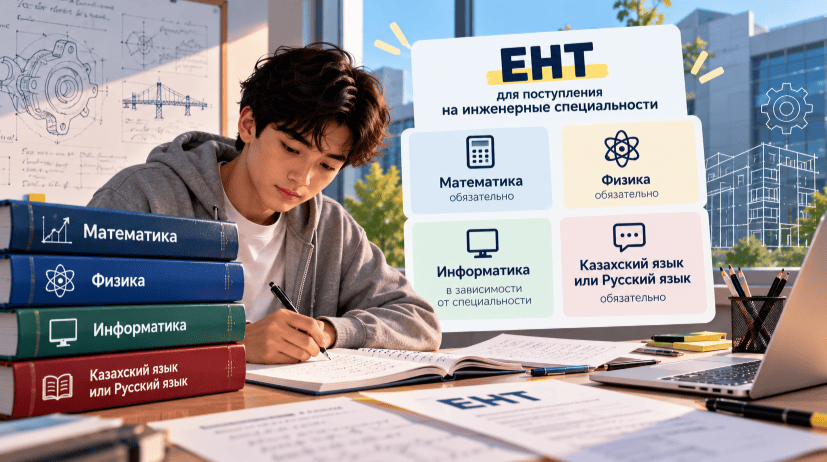
Maths and Physics: the Foundation for Technical Degrees
For most engineering degrees in Kazakhstan, the specialised subjects in the UNT are mathematics and physics. The UNT (Unified National Testing) is Kazakhstan’s school leaving exam and university entrance test in one. This combination is required for electrical engineering, energy, automation and many other technical fields.
But engineers differ. Someone who designs power grids and someone who writes software for servers take different subjects. Below we look at how the UNT works, which combinations lead to engineering and how to make the right choice while still in Grade 10.
How the UNT Works: Compulsory and Specialised Subjects
The UNT consists of five subjects. Three are compulsory for everyone, and the applicant chooses the two specialised ones.
- History of Kazakhstan: 20 tasks.
- Reading literacy: 10 tasks.
- Mathematical literacy: 10 tasks.
- Two specialised subjects: 40 tasks each.
The maximum score is 140 points. Most of it comes from the specialised subjects, so the choice of combination affects the result more than it seems.
One important detail: in the main UNT session, a school leaver chooses one combination of specialised subjects for both attempts. It can be changed no later than 24 hours before the test. So it is better to decide in advance rather than on the day of registration.
Why Engineers Take Physics
Physics is the language every technology speaks. Current in a wire, a motor heating up, the way a sensor works, the strength of a structure: all of this is described by the laws of physics. Engineering students need mechanics, electricity and magnetism from their very first year. If this foundation was not built at school, they will have to catch up in the most demanding semester.
There is also a practical reason. The combination of mathematics and physics gives access to a large number of programme groups and therefore to grant competitions in many fields. According to the National Testing Centre, it has been the most popular combination among applicants for several years.
Which Combinations Lead to Engineering
The list of programme groups and their specialised subjects is published every year by the National Testing Centre (NTC). Below are examples valid for 2026.
| Field | Specialised subjects | Example programme group |
|---|---|---|
| Electrical engineering and automation | Mathematics and physics | B063 |
| Physics | Mathematics and physics | B054 |
| Mathematics and statistics | Mathematics and physics | B055 |
| Information technology | Mathematics and computer science | B057 |
| Information security | Mathematics and computer science | B058 |
Before choosing, check your programme group in the current NTC directory. Combinations are sometimes revised. In 2024, for example, it was proposed to switch the groups “Electrical engineering and automation” and “Mathematics and statistics” to mathematics and computer science, but physics was kept after applicants asked for it.
Physics or Computer Science: How to Choose?
A simple question helps: what is more interesting, hardware or code?
If you are curious how power grids, devices, robots or medical equipment work, that is hardware engineering, and it requires physics. These professions involve programming too, but the code serves the hardware: it controls equipment, processes signals and collects data from sensors.
If you are drawn to app development, databases or cybersecurity, a combination with computer science makes more sense. That is the path into IT as an industry of its own.
There is a middle option as well. Programmes that combine electrical engineering and information technology usually admit students with physics and mathematics. Their graduates understand both how equipment is built and how its software works. The careers this field opens up are covered in the article Electrical Engineering and IT: careers and opportunities.
How Many Points Do You Need for an Engineering Degree?
There is no single answer. Thresholds depend on the university and the programme group, and universities may set their own. Grants are also awarded through a competition, so the final passing score differs from year to year.
At the Branch of Anhalt University of Applied Sciences in Kazakhstan, the requirements are as follows:
| Programme | Specialised subjects | Grant | Paid tuition |
|---|---|---|---|
| Electrical Engineering and Information Technology | Physics and mathematics | from 70 points | from 50 points + internal exam |
| Biomedical Engineering | Physics and mathematics | from 70 points | from 50 points + internal exam |
For paid admission, the internal exam tests the same subjects, physics and mathematics. Current requirements and deadlines are published on the page for applicants, and it is worth checking them again before each admission period.
When to Decide and How to Prepare
Grade 10 is the best time to choose specialised subjects. A year and a half is enough to fill gaps in physics without rushing and to get used to the test format.
A possible sequence:
- Pick two or three degrees you are interested in and check which subjects they require.
- Take practice tests in both combinations and compare the results.
- Choose one combination and focus on it.
- Use the January UNT as practice. In 2026, the main testing period ran from 10 May to 10 July.
- After every attempt, review the topic analysis: it shows which topics are weak.
If the chosen programme is taught in English, language proficiency must be confirmed separately. For the branch’s engineering programmes, for example, IELTS from 5.5, TOEFL from 69 or a free internal English exam are accepted. Preparing for it alongside the UNT is easier than leaving it for the summer.
Who the Combination of Mathematics and Physics Suits
- Those who want to work with technology: energy, electronics, automation, medical equipment.
- Those who have not yet chosen a specific field: this combination keeps the widest choice of programme groups.
- Those considering study under the German applied sciences model with many labs and projects. How this format works is explained in the article What Is a University of Applied Sciences.
- Those who find physics hard but are interested in technology: the time before the UNT can go into systematic preparation.
Conclusion: Career First, Subjects Second
For most engineering degrees, the right choice is mathematics and physics. Mathematics and computer science suit those heading specifically into programming and cybersecurity. The main rule is simple: first understand what kind of work interests you, then check the subjects in the NTC directory, and only then register for the UNT.
If you are considering engineering programmes taught in English with two degrees, see the study programmes of the Branch of Anhalt University of Applied Sciences in Kazakhstan or ask the admissions office at anhalt.university.