
How to Prepare for IELTS in Six Months: a Plan for School Students
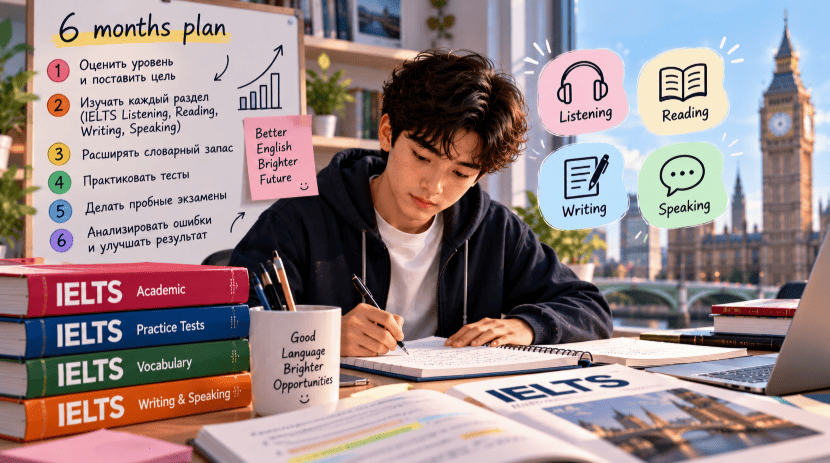
Six Months Is Enough if You Start with a Diagnosis
Six months is usually enough to prepare for IELTS to the level required for programmes taught in English. The engineering programmes of the Branch of Anhalt University of Applied Sciences in Kazakhstan, for example, require a score of 5.5 or higher. The key condition is to start not with a textbook but with an honest check of your current level.
The difficulty is that school leavers are preparing for the UNT, Kazakhstan’s national entrance test, at the same time. So the plan below assumes 4 to 6 hours of English a week rather than lessons from morning till night.
What IELTS Academic Is and What It Consists Of
For university admission, candidates take IELTS Academic. There is also General Training, but it is mainly used for migration and work, and universities usually do not accept it.
The exam tests four skills:
| Part | Time | What it includes |
|---|---|---|
| Listening | about 30 minutes | 40 questions on recordings that are played only once |
| Reading | 60 minutes | 40 questions on three long academic texts |
| Writing | 60 minutes | Describing a graph or diagram, plus an essay |
| Speaking | 11 to 14 minutes | A conversation with an examiner in three parts |
Listening, Reading and Writing are taken on the same day without breaks. Speaking is sometimes scheduled for another day.
Each part is scored on a scale from 0 to 9. The overall score is the average of the four parts, rounded to the nearest half band. A weak Writing score can therefore be partly offset by a strong Listening score, but failing one part still pulls the overall result down.
Month 1: Find Out Where You Are
The first two weeks go into diagnosis. Take a full practice test from official materials and keep strictly to the time limits. No dictionary and no pauses.
After the test, the main thing becomes clear: which part is weakest. For most school students, it is Writing and Speaking. Schools teach reading and listening, but hardly anyone practises writing an essay or speaking for two minutes without preparation.
Next comes a simple schedule, for example:
- Two lessons a week of 1.5 hours each: task analysis and technique.
- Three sessions of 30 minutes: vocabulary and listening on the go.
- Once a week: a written task that someone checks.
Months 2 and 3: Technique for Each Part
IELTS tests not only language but also how well you handle the format. Strong students who have not prepared for the format often lose points simply because they do not know the task types.
At this stage, go through each question type:
- Reading: finding answers by keywords, True / False / Not Given tasks, matching headings to paragraphs.
- Listening: reading the questions in advance and following the recording.
- Writing: a template for describing graphs and an essay structure (introduction, two arguments, conclusion).
- Speaking: answering in full sentences rather than single words, and a two minute talk based on a task card.
It is best to show your Writing to a teacher or a native speaker from the start. Assessing your own essay against the IELTS criteria is almost impossible.
Months 4 and 5: Practice Tests and Working on Mistakes
Now take a full practice test every two weeks. What matters is not the number of tests but analysing every mistake. A simple table helps: task type, where the mistake happened, why.
By this point it is usually clear what score is realistic. If practice tests consistently give you the score you need, you can register for the exam. If you are more than one band short, it is wiser to move the date than to spend money on an unsuccessful attempt.
Month 6: the Exam and a Time Buffer
Choose the exam date with a buffer, so that the result arrives before the application deadline and there is time for a retake if needed. Check result times and available dates with the test centre in advance, because spring dates fill up quickly.
If you plan to compete for a state grant, show your certificate to the admissions office of your chosen university in advance. At the Hochschule Anhalt branch, for example, IELTS and TOEFL certificates are checked before the grant application: without this check, the university cannot be selected on the eGov and Testcenter platforms.
Common Mistakes in Preparation
- Memorising word lists without context. Words stick when you meet them in texts and use them in essays.
- Preparing only for Reading and Listening because they are easier to check on your own.
- Not practising writing by hand or on a computer in the format used in the exam.
- Registering for the exam on the off chance, without practice tests.
- Putting English off until summer, when all the energy goes into the UNT.
What If You Have No Certificate or Your Score Is Too Low?
IELTS is not the only route. For the branch’s programmes, the following are accepted:
| Option | Minimum result | Features |
|---|---|---|
| IELTS Academic | from 5.5 | Paid exam, international certificate |
| TOEFL iBT | from 69 | Paid exam, fully computer based |
| Internal exam | pass | Free, DAAD standard, held in May and June |
The internal exam is written and has three parts of 25 minutes each: a test, reading comprehension and a short essay. Dates and registration are on the English exam page. It is a good backup option, but it still requires preparation: its format is quite similar to the academic tasks in IELTS.
Who This Plan Suits
- School leavers with English at around B1 who need a score of 5.5 or 6.0.
- Those preparing for the UNT who cannot spend several hours on English every day.
- Those planning to study on English taught programmes in Kazakhstan or abroad.
- Those who want a safety net: practice tests will show whether a backup option is needed.
Conclusion: Consistency Beats Cramming
Six months of regular study gives more than a month of cramming before the exam. Start with a practice test, work on your weakest part and take the exam only when your practice results consistently reach the required score. English matters beyond admission: on programmes taught in English, all teaching is in English from the very first day. The degrees graduates of such programmes receive are explained in the article Double Degree: what graduates receive.
English requirements and admission deadlines for all programmes are listed on the page for applicants. If you have questions, ask the admissions office at anhalt.university.